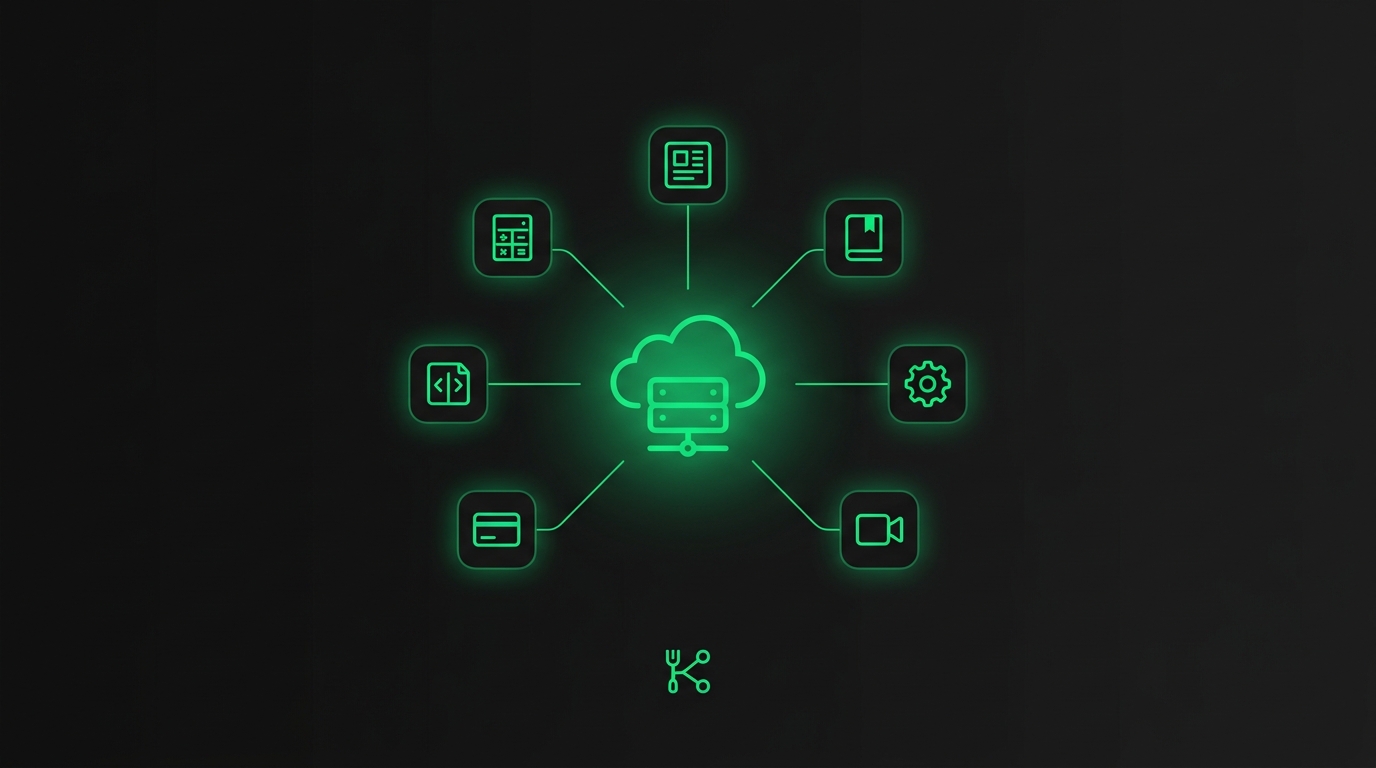
When I launched Newton, every customer got a private VPS and an AI agent ready to use — auto-provisioned in about 2 minutes. But I kept hearing the same thing from new customers: "Okay, I have a server and an AI. Now what?" They didn't know where to start. An empty server with a chat window isn't very inspiring. So I started thinking about what else I could give them — and the answer was sitting right in front of me.
The 6 Apps I Share With Every Newton Customer
I've been building my own tools for over a year now. Not demo apps. Not tutorial projects. Real tools that run my actual business, every single day. I realized that if Newton customers could clone these onto their own servers, they'd essentially get 6 free SaaS products — plus an AI agent that can customize any of them without limits.
Here's what every Newton customer gets access to:
- Accy — my accounting system. Upload a credit card PDF, it auto-extracts every line item, categorizes expenses, and exports to Google Sheets for my bookkeeper. I use it every month.
- Documentor — a content platform for creating and scheduling posts to Facebook and Instagram. Built-in research module, image generation, draft scheduling — the whole pipeline.
- Libra — a dashboard for managing Amazon KDP ebooks. Everything from writing to publishing in one place.
- Loom — my Facebook page automation engine. Runs dozens of pages simultaneously with LLM workflows, AI image generation, and ad campaign management.
- Pointer — a credit card promo finder. Enter the cards you have, it tells you which dining deals and point redemptions are worth using right now.
- TJ Live — an automated live stream clip cutter. One button after a live — AI picks the best moments, cuts them, writes captions, and schedules posts across 4 platforms.
All 6 are apps I use daily. When there's a bug, I hit it first and fix it the same day. When I add a feature for myself, customers get it on the next git pull. These aren't abandoned side projects — they're living, maintained software.
The Problem: My Code Was Full of My Secrets
When I first told my AI agent Tim to "share these apps with Newton customers," the response was short: "Sure, but we need to sanitize them first."
I opened the repos and immediately understood why.
Every app had my personal credentials hardcoded everywhere — Telegram bot tokens sitting directly in Python files, Brevo API keys in config files, my Facebook Page IDs written straight into scripts, database passwords in tracked files that had already been pushed to Git.
If someone cloned these repos as-is, they'd get my credentials along with the code. Obviously that couldn't happen.
On top of that, several apps had tight integrations with my other services. Documentor talked directly to Loom. Accy sent notifications to my private Telegram group. If a customer didn't have those services running, the entire app would crash on startup.
Three Steps to Make Personal Code Shareable
Tim handled the sanitization as a standardized pattern. Every app went through the same three steps before it was cleared for sharing.
Step 1 — Strip Every Credential
Tim grepped every repo for anything that looked like a credential — API keys, tokens, passwords, page IDs, anything specific to me. Everything moved into .env files. Files that shouldn't be in Git at all (personal cron scripts, GitHub Actions workflows with SSH keys) got untracked and gitignored.
This sounds simple, but across 6 apps built over many months, credentials were buried in dozens of files — .py, .html, .sh. Tim audited every single one.
Step 2 — Make Every Integration Optional
For example, my Documentor talks to Brevo for email marketing. If a customer doesn't use Brevo, the whole app shouldn't break because of it.
Tim changed every external integration from "call it directly" to "check if the env var exists first — if not, skip it." Every service dependency became optional. An app works perfectly fine even if it's not connected to a single external service.
Step 3 — Add a Setup Wizard
This is my favorite part. Every app now has the same first-run experience: open the app, see a setup page, enter your email and password, done. The system auto-generates a JWT key, writes the .env file, and you never have to touch the terminal.
Tim standardized this across all 6 apps — same API endpoints (/api/setup-status to check, /api/setup to configure), same UI pattern. Customers see the same familiar setup flow no matter which app they open. No learning curve per app.
How Customers Get Access: GitHub Teams
I manage all the repos under my GitHub organization. There's a team called newton — every customer who connects their GitHub username in the Newton dashboard automatically gets read access to all 6 repos.
Want to use one of the apps? Just tell your AI agent: "Clone Accy and set it up for me." The AI on the customer's server runs git clone, installs dependencies, opens the setup wizard — done in 5 minutes.
And because it's all Git-based, when I push an update, customers just git pull. No waiting for releases, no downloading new versions. It's like a free lifetime subscription that actually gets better over time.
Why Not Just Use Existing SaaS?
People ask me: "Why not just tell customers to use Xero instead of Accy, or Buffer instead of Documentor?"
Three reasons.
Cost. Newton customers already pay for their server. These apps run on the same box. No additional subscriptions, no per-seat pricing, no feature gates. Use all 6, no extra charge.
AI can customize everything. If a customer wants Accy to categorize expenses differently, or Documentor to post on a different schedule, they just tell their AI to change the code. It's on their server, their code, their rules. No feature requests, no waiting for the next release.
Data stays local. No exporting data out of Xero. No begging Buffer for API access. Everything lives on the customer's own server. The AI has direct database access and can build cross-app pipelines — because all the data is right there.
Real Example: A Freelancer Clones Accy
One Newton customer is a freelancer juggling multiple projects. Every month he'd download credit card PDFs from his bank, manually split transactions in Excel, and email the spreadsheet to his accountant. Classic tedious workflow.
I told him to try Accy. He typed one sentence in his AI chat: "Install Accy for me." His AI cloned the repo, ran pip install, launched the setup wizard, set up the systemd service — 5 minutes, start to finish.
Now he uploads his credit card PDF, Accy auto-extracts every transaction, categorizes them, and exports to Google Sheets. His accountant gets a clean spreadsheet instead of a messy PDF.
The best part? Because it's his code on his server, he had his AI customize the expense categories to match exactly what his specific accountant expects. No feature request. No waiting. Just "hey AI, change the categories to these" and it was done.
What I Learned From Sharing My Personal Code
Honestly, I was nervous. I was worried customers would see messy code. Worried a credential might slip through. Worried about the maintenance burden.
But something unexpected happened. Once Tim sanitized everything through the same pattern — strip credentials, make integrations optional, add setup wizard — my own codebase got better too. No more hardcoded secrets. Every integration gracefully handles missing config. Every app has a clean onboarding flow.
Sharing my code forced me to write better code. Because if someone else can use it, I can maintain it more easily too.
If you're a solopreneur who's been building AI-powered tools for yourself and wondering what to do next — your tools might be more valuable than you think. The apps I built to solve my own problems turned out to be exactly what my customers needed. All it took was cleaning them up properly and delivering them the right way. That's what Newton is — a private server, an AI agent that knows your business, and 6 real production apps ready to clone and customize. Not an empty server with a chatbot. A system with real tools, ready to go. Check out /newton and see if it fits your stack.
— Pond