
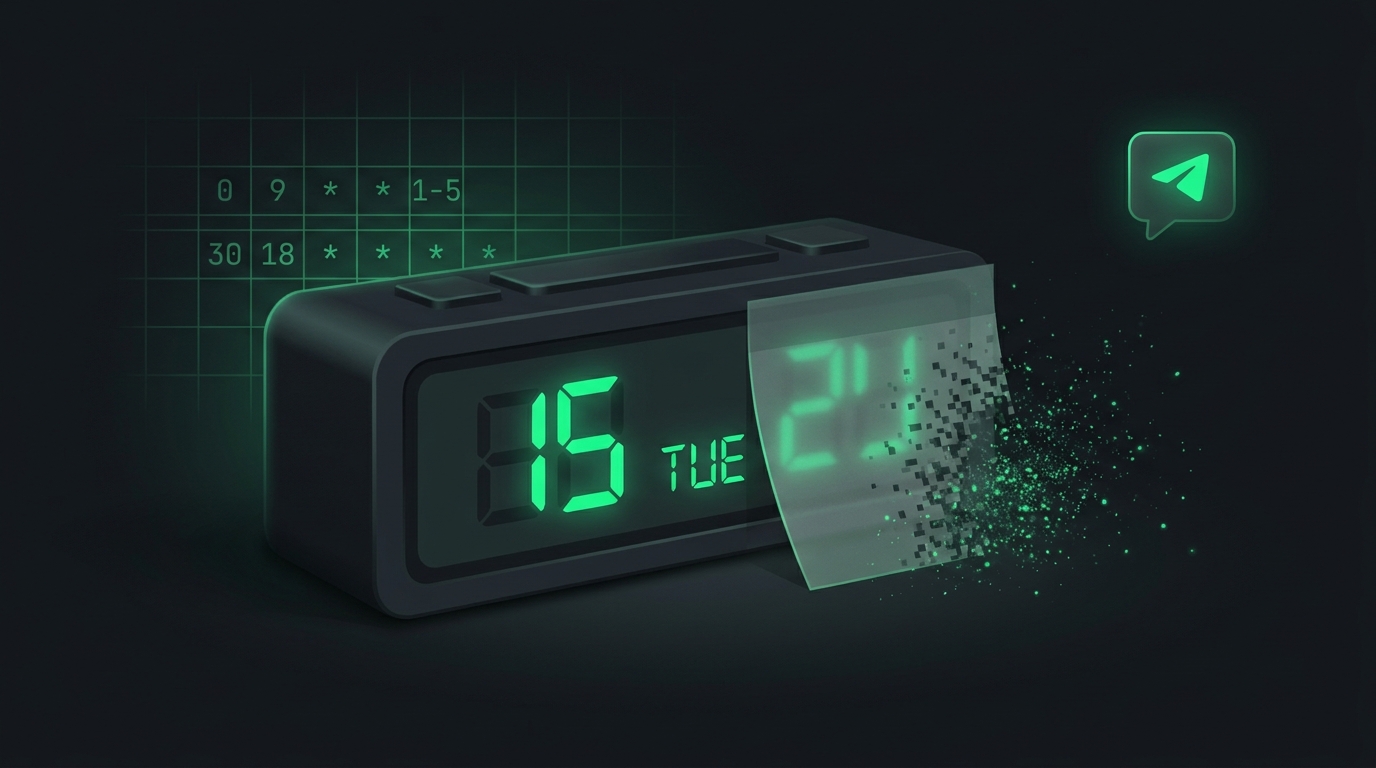
The thing I forget most often running a business isn't today's work. It's the stuff that's coming "two weeks from now." When a price goes up, when a contract lapses, when a vendor changes a policy. By the time the date actually arrives, it's gone from my head completely. Last week I hit two of those at once — and the way my AI handled it is worth telling.
Because my AI didn't "make a note" the way ChatGPT would. It actually set an alarm clock for that exact day — and then deleted the alarm clock once it had gone off.
Two Future Deadlines I Knew I'd Forget
I was reading tech news and ran into two things that hit my business directly — and both happen to land on the exact same day, June 15, 2026:
- Hetzner is changing prices — Hetzner is the host I rent every server from. Existing machines aren't affected, but the moment I spin up a new box or rescale an old one, it's the new price. And they don't publish the numbers ahead of time — you have to check the site that day.
- Anthropic is changing a policy — they're splitting the API pool for
claude -pmode, which is the exact mode my automation and cron jobs use to run background work for Newton and my content pipeline. If I don't check the quota carefully, jobs could start failing quietly.
Neither one is something I have to act on today. They're the kind of thing where forgetting on the day itself is what costs you. So I told my AI one short sentence: "Remind me on June 15 about Hetzner and claude -p."
A normal person — or a normal AI chat — replies "Got it, noted." Which means nothing actually happens. A chat window has no existence once I close it. When the 15th rolls around, there's nobody there to remind me.
It Chose a System Cron — Because It Has to Fire When No Chat Is Open
My AI didn't write it to memory and hope someone opens the file that day. It wrote a small script and registered a system cron to fire at 9:30 the morning of June 15 and push a message straight into my Telegram group.
This is the part that matters — cron runs at the server level. It has nothing to do with whether I have a chat window open. I can be asleep, on a trip, or have completely forgotten I ever asked — when the time comes, it pings me anyway. That's the difference between "an AI that's just a chat window" and "an AI that lives on your machine around the clock."
But what I really want to show you is two details my AI put in the script on its own, without me asking — and they're exactly what separates "writing code that works" from "writing code that's correct."
Detail #1: Fire Once, Then Delete Its Own Cron Line
Here's the catch: cron is built to do things repeatedly — every day, every week, every month. It has no built-in "do this one time and stop" mode.
If I naively set a cron to "fire every June 15," it reminds me correctly this year — but next year, and the year after, and every June 15 for the rest of time, it keeps nagging me about the same thing, long after Hetzner and claude -p stopped mattering. That's garbage piling up in the system.
So my AI made the script "kill itself" after it runs — the last line of the script opens the machine's crontab, removes the line that calls itself, and saves it back:
- Cron fires → sends me the Telegram reminder
- Reminder done → the script opens the crontab and deletes its own line
- Next cycle → nothing left to fire. Clean.
The simplest way to picture it: a sticky note on the fridge that says "pay the water bill." But the moment you pay it, the note tears itself off and throws itself away. You never have to come back and clean up. No stale notes cluttering the fridge. (It's the same instinct I loved when my AI once deleted its own alert system after it stopped being useful — cleaning up after itself instead of leaving cruft behind.)
Detail #2: A Year-Guard, In Case the Self-Delete Fails
This is the part I liked best, because it's planning for "what if Detail #1 breaks."
Suppose on June 15 the machine happens to be having a bad moment and the cron deletion doesn't go through — a network hiccup, the crontab is locked, whatever. The cron line stays behind, and next year on June 15 it fires off a reminder about something that's been dead for a year.
So my AI added a "second gate" at the very top of the script — before it does anything, it checks: is the current year 2026? If not, it exits immediately and sends nothing:
- Year is 2026 → run normally: remind, then self-delete
- Year 2027 or later (in case the line lingered) → exit silently, don't bother me
So there are two layers of protection. The first (self-delete) is the main path. The second (year-guard) is the safety net if the main path slips. Even if something goes wrong, there's no way I get reminded in the wrong year. This is the kind of defensive coding a system that actually runs in production needs — not assuming everything will always go perfectly.
And It Doesn't Just "Remind" — It Offers to Do the Work
The message my AI queued up for that morning doesn't stop at "hey, two things today." It ends by asking me: "Want me to pull the real Hetzner prices off the site and check the claude -p impact for you right now?"
See the difference? A normal calendar reminder pings you and that's it — the burden is still entirely on you. You still have to go open Hetzner's site, go chase down the quota yourself. My AI reminds me and sticks its hand out: "one reply and I'll handle it." Because it isn't just a reminder. It's an agent that can actually carry the work forward.
Why a Tiny Thing Like This Matters If You Run a Business
Count up how many future deadlines you hit in a year that "cost money if you forget":
- Domain/hosting auto-renewals that jump in price after year one
- Free trials on tools you signed up for, about to charge full freight
- Ad promos you need to pause before the month closes
- Vendor pricing or policy changes landing a few weeks out
This is money that leaks out quietly because nobody remembers. Setting a calendar entry for every single one is tedious. Hiring someone to remember for you isn't worth it. It's the perfect example of a job that's great to do if doing it is cheap enough — and otherwise just slides.
With my AI, I typed one sentence the moment I saw the news — "remind me on the 15th" — and then forgot about it entirely, because I know that when the day comes, a message will pop up on its own, with an offer to handle the rest. No stale cron left behind. No reminder firing in the wrong year.
If you're a one-person business whose head is so full of today's work that the thing two weeks out always slips — having your own AI agent that lives on your server full-time, can set its own reminders, and can pick up the work from there changes how you operate. That's exactly what Newton is — a private server with an AI agent already wired up. Tell it to set a reminder, write a cron to babysit a background job, or chase down the deadlines you always forget — without writing a single line of code. See how it works →
— Pond